How to Validate Your Startup Idea Before Launch
Starting a startup sounds exciting, but most startup ideas fail because they are not validated properly. Many founders jump straight into product development, only to realise later that their idea was not solving a real problem.
If you want to build a successful startup, the first step is to validate your startup idea before investing time and money into a full product.
In this guide, you will learn a simple, practical validation process that helps you test your idea, understand your market, and make better decisions early.
Why Startup Idea Validation is Important
Startup idea validation helps you understand whether your idea is worth pursuing or not.
Instead of guessing, you use real data, user feedback, and market insights to make decisions.
Here's why validation is critical:
- Helps you avoid building something nobody wants
- Saves development cost
- Gives clarity on your target market
- Improves your chances of product-market fit
- Helps refine your business model
Without validation, you are taking a big risk.
👉 Join our Founder Partnership Program
If you have already validated your idea and want structured support to move forward, you can explore our Founder Partnership Program.
What Does It Mean to Validate Your Startup Idea?
To validate your startup idea means testing whether your idea solves a real problem and whether people are willing to pay for your solution.
It includes:
- Understanding your target audience
- Testing your value proposition
- Checking market demand
- Getting feedback from real users
Startup idea validation is not about perfection. It is about learning fast and improving your idea.
Step-by-Step Guide to Validating Your Startup Idea
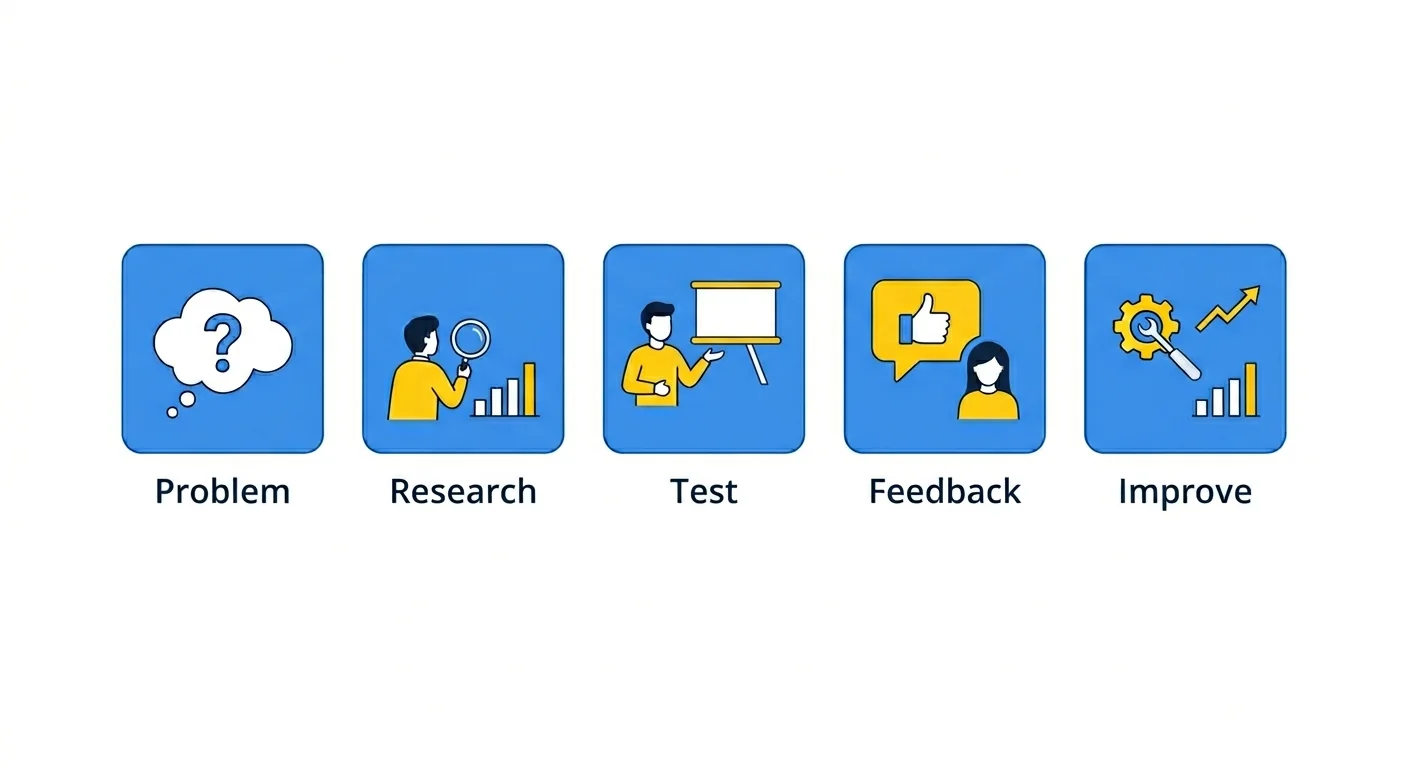
1. Identify the Core Problem (Pain Point)
Every startup begins with a problem.
Ask yourself:
- What problem am I solving?
- Is it a real pain point?
- How often do people face this issue?
If the problem is weak, your startup idea will not work.
Focus on a strong and clear problem.
2. Define Your Target Audience and Market
You need to clearly identify your target customer.
Think about:
- Age, profession, and behaviour
- Where they spend time online
- What problems they face
Understanding your target market helps you build something that resonates with your audience.
3. Perform Market Research and Competitive Analysis
Before building, you must do proper market research.
Check:
- Existing competitors
- Their strengths and weaknesses
- Market size and market opportunity
This step helps you understand whether there is a large enough market.
You can also use AI tools for market data and competitive analysis.
4. Validate Your Business Model Using a Framework
Use a simple validation framework like the business model canvas.
It helps you define:
- Value proposition
- Customer segments
- Revenue models
- Cost structure
This gives clarity on how your startup will work.
5. Create a Landing Page to Test Demand
A landing page is one of the best tools to validate your startup idea.
Your landing page should include:
- Problem explanation
- Your solution
- Key benefits
- Call to action
You can ask users to:
- Join a waitlist
- Sign up
- Show interest
If people take action, it means your idea has demand.
6. Use AI Tools for Faster Validation
AI has changed how startups validate ideas.
You can use AI-powered validation tools to:
- Analyse your idea
- Get market insights
- Generate customer personas
- Identify trends
Tools like ChatGPT can help you analyse your idea and improve your approach.
AI-powered validation accelerates the process, but always combine it with real feedback.
7. Talk to Potential Customers
This is the most important step.
Talk to real people and get feedback.
Ask questions like:
- Would you use this product?
- Would you pay for it?
- What problem do you currently face?
This helps you validate your idea directly from users.
You can use platforms like LinkedIn to connect with your target audience.
8. Build a Prototype or Mockup
Instead of building a full product, create a simple mockup.
This helps users understand your idea better.
You can test:
- User experience
- Interest level
- Feedback
This step is important for concept validation.
9. Test Market Demand with Real Users
Now test your idea in the real world.
You can:
- Run ads
- Share your landing page
- Collect sign-ups
The goal is to see if people are interested enough to use your product.
Real validation happens when users are willing to buy your product.
10. Refine Your Idea Based on Feedback
Use feedback to refine your startup idea.
- Improve your product
- Remove unnecessary features
- Focus on what users need
This is part of the lean startup approach.
👉 Join our Founder Partnership Program
Once you have validated your idea, you can explore our Founder Partnership Program to move towards building your MVP.
How AI Helps in Startup Idea Validation
AI is becoming a powerful tool for startup founders.
AI tools can help you:
- Analyse your idea
- Generate business plans
- Perform market analysis
- Predict trends
AI-powered validation can accelerate your process and provide actionable insights.
But remember, AI is a tool for entrepreneurs, not a replacement for real users.

B2B vs B2C Startup Validation Approaches
Validation is different for B2B and B2C startups.
B2B Validation
- Focus on solving business problems
- Talk to decision-makers
- Validate pricing and ROI
B2C Validation
- Focus on user experience
- Test emotional appeal
- Measure engagement
Understanding your target market helps you validate better.
Real-World Examples of Startup Validation
Many successful startups used simple validation techniques:
Dropbox
Created a demo video before building the product.
Airbnb
Tested demand with a basic website.
SaaS Startups
Use landing pages to validate before development.
These examples show that validation comes before building.
Common Mistakes in Startup Validation
Avoid these mistakes:
- Building too early
- Ignoring feedback
- Targeting everyone
- Overcomplicating the idea
- Relying only on AI-generated insights
Validation is about real users and real data.
Advanced Startup Validation Framework
Once you complete basic validation, go deeper.
Focus on:
- Product-market fit
- Market demand
- Customer behavior
- Revenue models
- Market insights
You should also test:
- Whether users will pay
- Whether your idea has long-term viability
- Whether your solution meets their needs
👉 Join our Founder Partnership Program
Once you've validated your idea, you can build your MVP with the Founder Partnership Program and move forward with clarity.
How to Know If Your Startup Idea is Worth Pursuing
Your startup idea is worth pursuing if:
- You get strong user interest
- You receive positive feedback
- There is a clear market opportunity
- Users are willing to pay
If not, you can pivot and improve your idea.
FAQs: Startup Idea Validation
How do I validate my startup idea quickly?
Start with a landing page, talk to users, and test demand using simple methods.
Can AI help validate startup ideas?
Yes, AI tools can provide insights, but real user feedback is still necessary.
What is the best validation method?
Talking to real users and testing demand is the most effective method.
Key Takeaways
- Always validate before building
- Focus on solving real problems
- Use AI as a support tool
- Test demand with real users
- Improve based on feedback
- Keep your startup idea simple
Ready to turn your startup idea into something real?
If you want expert guidance, faster validation, and a clear roadmap to build your product, don't do it alone.
Related articles




Nuno Dhiren
Founder, Internwise
You've learned how to validate your startup idea. Now it's time to build it the right way. Our Founder Partnership Program gives you structured guidance, expert mentorship, and a clear roadmap to turn your validated idea into a real, profitable business.
Join other ambitious founders who are building sustainable startups from day one.