Top Startup Idea Validation Methods Every Founder Should Know

Most startup ideas don't fail because they are bad. They fail because they were never properly validated.
Every founder starts with a "big idea". It feels exciting. It sounds promising. But the reality is often very different once you start testing it in the market.
This is where startup idea validation methods come in. Validation is not about guessing or trusting your instincts, it's about collecting real signals from real people before you invest deeply.
To truly validate a startup idea, you need a mix of approaches, talking to users, testing demand, and observing real behaviour.
In this guide, you'll learn practical startup idea validation methods that help you reduce risk, make better decisions, and build with confidence.
What Are Startup Idea Validation Methods?
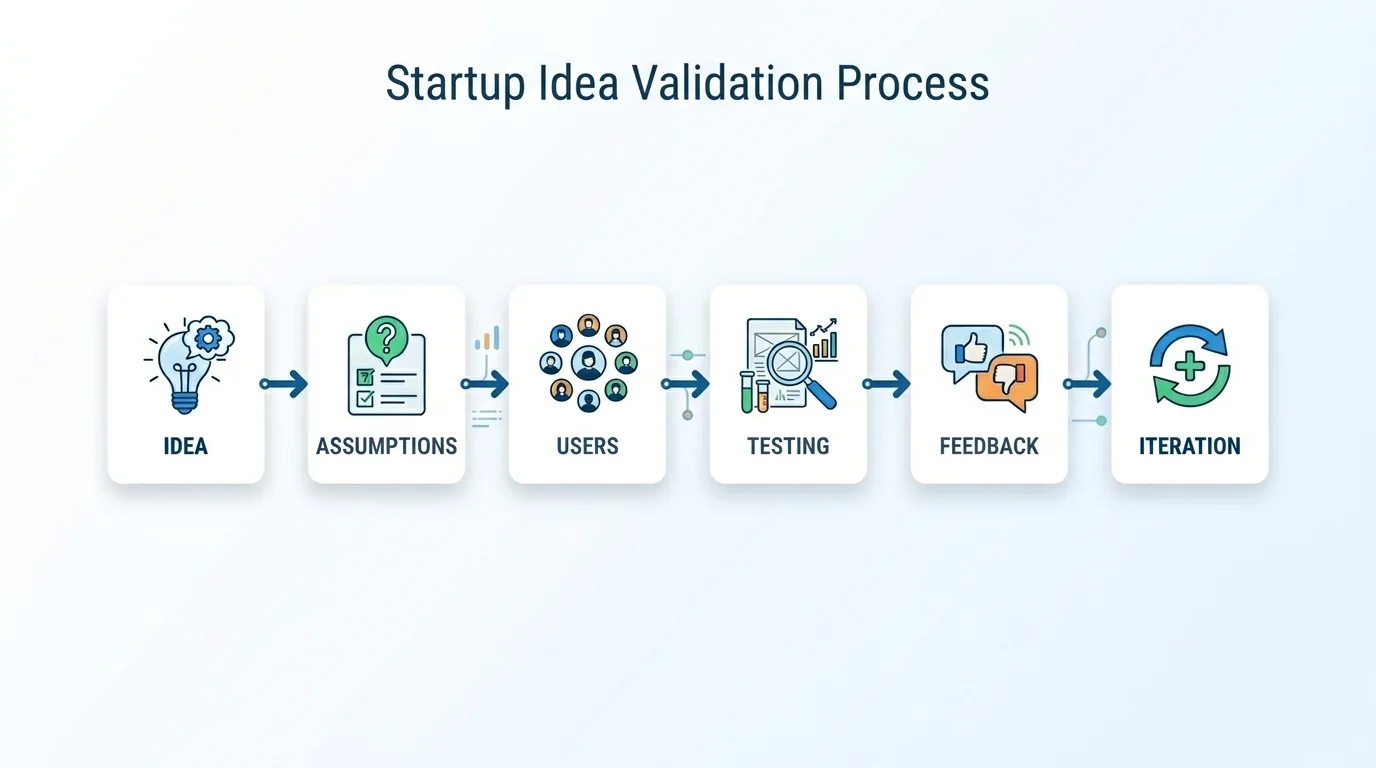
Startup idea validation methods are ways to test whether your idea actually works in the real world. At the core, idea validation is about answering one question: Do real people have this problem, and will they pay for your solution?
Most founders start with assumptions. You think people have a problem. You believe they will pay for your solution. But assumptions are not proof.
The validation process is a structured way to check if your startup idea solves a real problem for real users. It involves experiments, conversations, and data, not opinions.
Startup idea validation is not a one-time step. It's a continuous process. You start small, test quickly, learn, and then decide whether to move forward, adjust, or pivot.
Instead of relying on gut feeling, strong founders follow a simple framework: identify assumptions, test them in the market, and use the results to make decisions.
Why One Validation Method Is Not Enough
Many founders make the mistake of relying on just one signal to validate their startup idea. Maybe a few people said, "This sounds great." Maybe your landing page got some traffic. Maybe a friend in the industry gave positive feedback.
The problem is false positives. People often say they like an idea, but that doesn't mean they will use it or pay for it.
To truly reduce the risk, you need multiple signals. Combine qualitative insights, like user interviews, with quantitative data, like landing page conversions or ad clicks.
Strong validation comes from patterns, not opinions. The more consistent signals you see, the higher your chance of success.
Types of Startup Idea Validation Methods
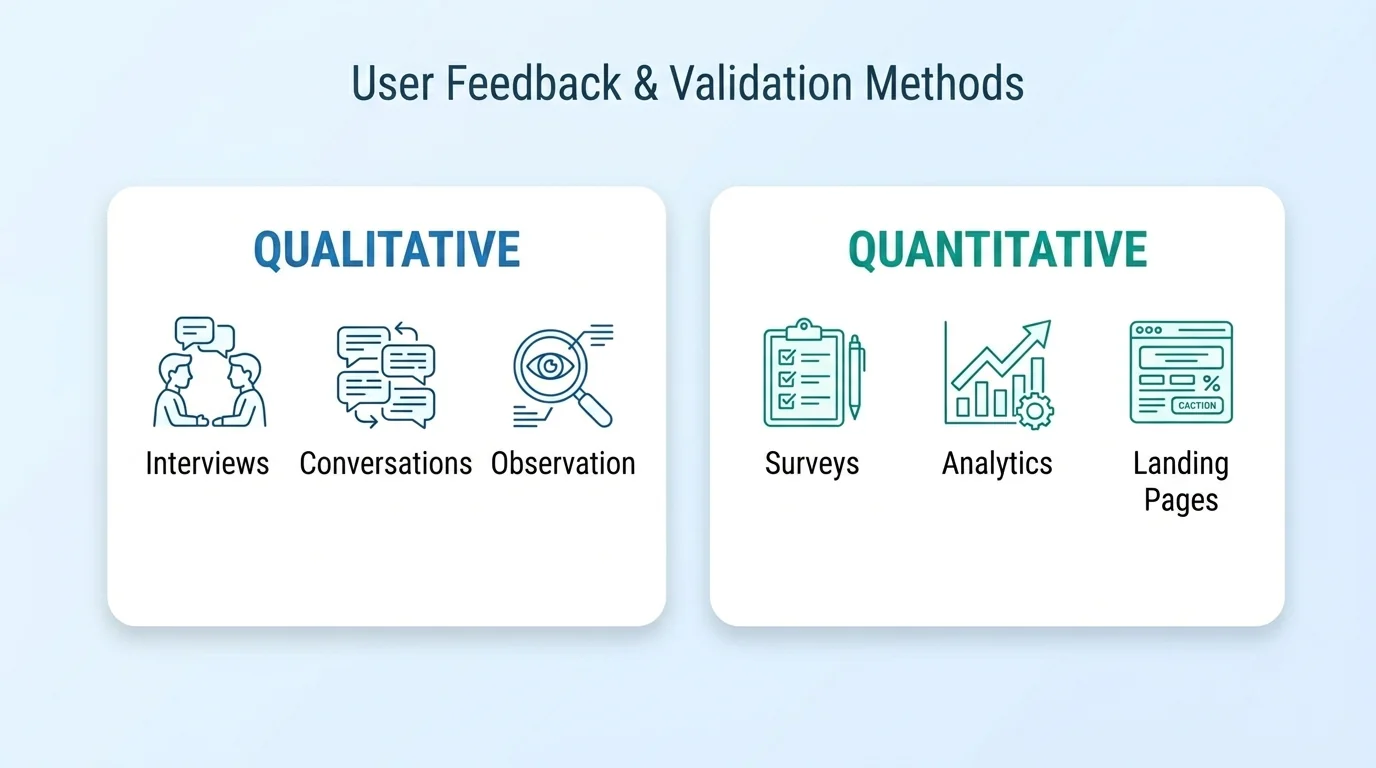
To properly validate a startup idea, you need to look at it from different angles. Broadly, startup idea validation methods fall into two categories.
Qualitative Methods (Understanding Users)
Qualitative methods focus on learning directly from people. The goal is to understand their problems, behaviour, and mindset.
Instead of pitching your idea, you talk to real people and explore their pain points. What problems do they face? How are they solving them today? What frustrates them about current solutions?
These conversations help you avoid building something based on assumptions. You start to see patterns in real user needs.
Quantitative Methods (Measuring Interest)
Once you understand the problem, the next step is to measure demand. Quantitative methods help you test if your target audience is large enough and interested enough.
You can run a simple survey to gather structured feedback at scale. Or create a landing page that explains your idea and tracks how many people sign up.
These methods give you numbers, not just opinions. And numbers help you make better decisions before investing too much time and money.
Top Startup Idea Validation Methods Every Founder Should Know
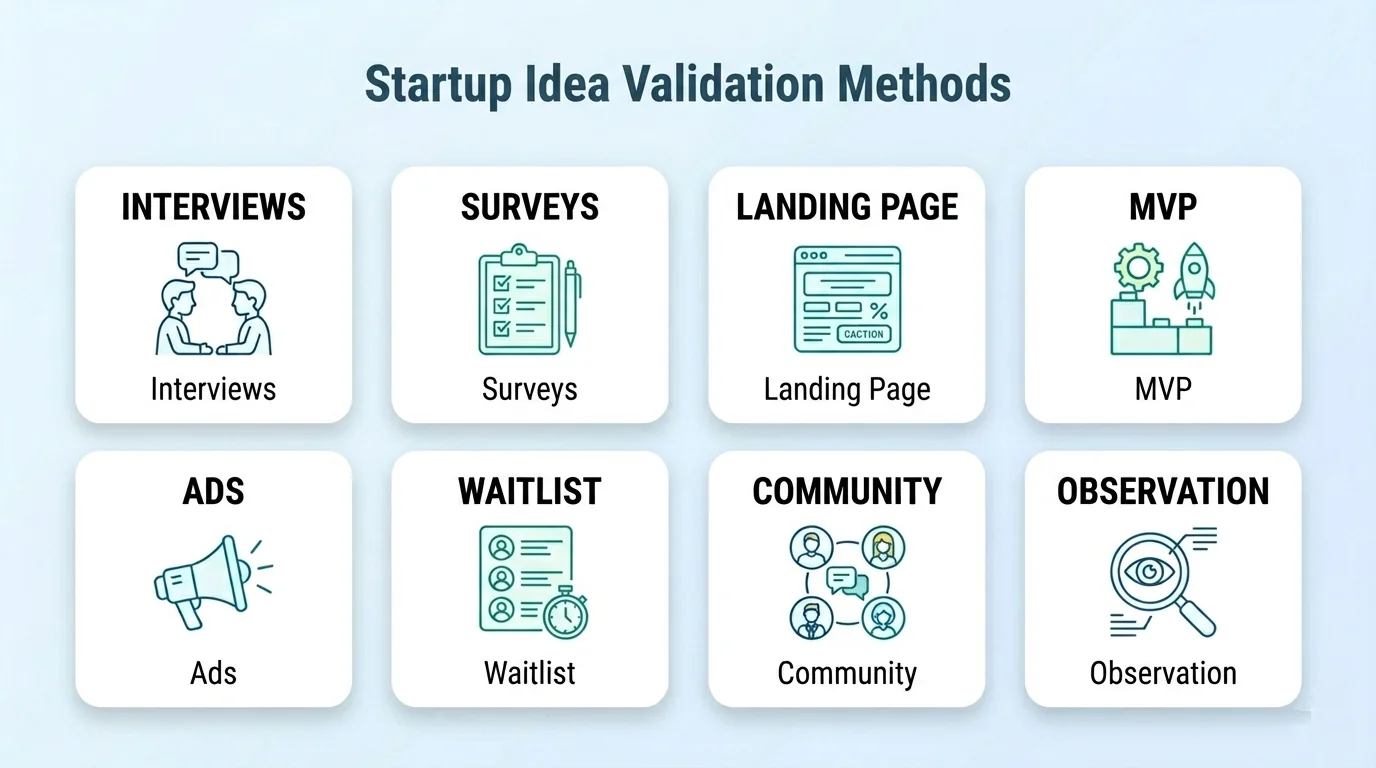
If you want to validate your startup idea properly, you need practical methods, not theory. Below are the most effective startup idea validation methods used by successful founders.
User Interviews
User interviews are the starting point of validation. You speak directly with potential users to understand their problems, behaviour, and pain points.
Focus on listening, not pitching. Ask about their current behaviour and pain points. If people clearly describe a problem that matches your idea, that's a strong early signal.
Surveys
Surveys help you validate ideas at scale. After initial conversations, you can send a survey to a broader audience to confirm patterns.
Keep questions simple and focused. Avoid leading questions. Look for consistent responses across your target group. If many people report the same problem, it suggests real demand.
Landing Pages
A simple landing page is one of the fastest ways to test interest. You describe your product or service, highlight the problem you solve, and add a clear call to action, like signing up or joining a waitlist.
This method works well before building anything. Track how many visitors convert. If people are willing to share their email, it shows real interest.
MVP (Minimum Viable Product)
An MVP is a basic version of your product with just enough features to test core value. You use it when you want to move beyond conversations and see how users actually interact with your solution.
The goal is not perfection, it's learning. Watch how users interact with your MVP. Are they using it repeatedly? Are they asking for more? That's real validation.
Waitlists
A waitlist helps you measure early demand before launch. You collect emails from interested users and build a list of early adopters.
This method works well alongside a landing page. A growing waitlist shows curiosity, but more importantly, it shows intent.
Pre-orders
Pre-orders are one of the strongest validation signals. Here, people are willing to pay before the product is fully built.
This method directly tests if your idea can attract paying customers. Even some pre-orders can prove real demand. If no one pre-orders, that's also important data.
Ads Testing
Running small ad campaigns helps you test market interest quickly. You create ads around your idea and direct traffic to a landing page or waitlist.
This works best when you want fast feedback. Measure clicks, sign-ups, and cost per conversion. If people click but don't convert, your messaging might need work.
Community Validation (Reddit, LinkedIn)
Online communities like Reddit and LinkedIn are powerful for validation. You can share your idea, ask questions, and observe how people respond.
Look for honest feedback, not just praise. Communities often highlight problems you didn't consider. If people engage, ask follow-up questions, or share your post, that's a positive signal.
How to Choose the Right Validation Method
Not every validation method fits every stage. The right approach depends on where you are in your journey.
At the early stage, when your idea is still rough, focus on user interviews and small conversations. This helps you understand the problem deeply before testing any solutions.
If you already have something built, even a basic MVP, shift your focus to real usage. Track how people interact with your product and what they do after the first visit.
Your resources also matter. If you have limited time or budget, start lean. Talk to people, use free tools, and test manually before investing in ads or development.
The choice also depends on your target market. In B2B, direct conversations and relationship-building work best because decisions involve multiple people. In B2C, landing pages and ads can give faster results.
The key is simple: match the method to your stage, audience, and resources.
How to Evaluate If Your Validation Worked
Validation is not about hearing, "This is a good idea." It's about real signals that show people are ready to act. There's a big difference between fake validation and real traction.
Fake validation looks like compliments, likes, or vague interest. People say they would use it, but don't actually do anything.
Start by tracking simple metrics. Are people converting on your landing page? Are you getting consistent signups? More importantly, are any of those users willing to pay?
You should also look for early signs of market fit. Are users coming back without reminders? Are they recommending your product to others? Are they frustrated when something doesn't work, because they actually need it?
The goal is to get traction, not just feedback. If people take action without being pushed, your validation is working. That's when you know it's time to move forward.
Common Mistakes When Using Validation Methods
Many founders go through the validation phase but still get it wrong. The issue is not the method. It's how they use it.
One common mistake is talking to the wrong audience. If your target users are not clearly defined, your customer feedback will be misleading. You need input from people who actually face the problem.
Another mistake is asking biased questions. Founders often try to "sell" their idea during interviews or focus groups. This leads to polite, positive responses, not honest ones.
Ignoring negative feedback is also risky. If users highlight issues, and you dismiss them, you lose valuable insights. Validation requires you to stay objective.
The biggest trap is the "loved the idea" response. It feels good, but it's not validation. What matters is action. If people like your idea but won't sign up, pay, or return, the demand isn't strong enough yet.
When to Move Forward, Refine, or Pivot
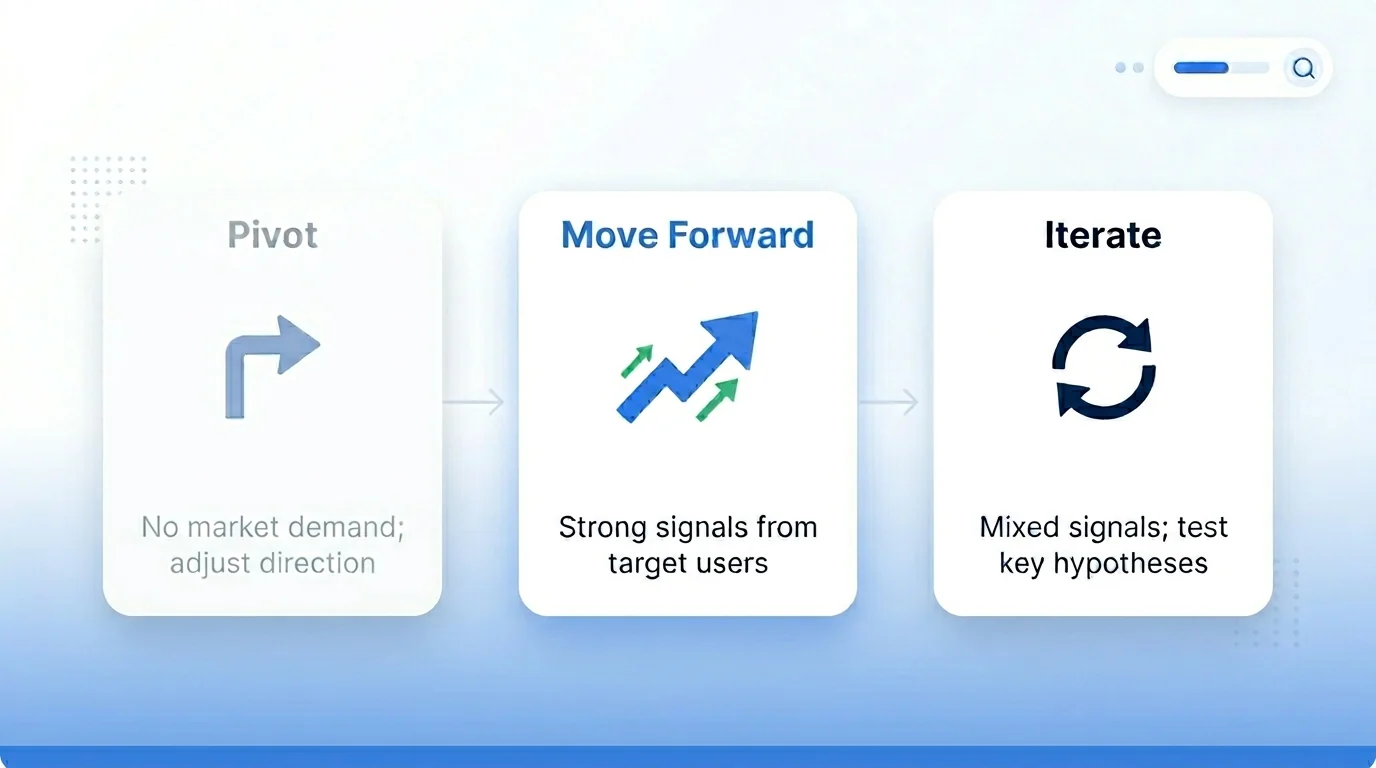
Validation only matters if you act on it. The real decision comes after you review the signals.
If you start seeing traction, consistent signups, active users, or even a few paying customers, it's a good sign to move forward. Build more, test further, and start planning your next steps.
If the signals are mixed, don't rush. This is your chance to iterate. Maybe the problem is right, but the solution needs work. Maybe the audience needs refining. Go back, adjust, and test again.
If there is little to no demand, it's better to pivot or even drop the idea. It's tough, but it saves time and energy in the long run.
Not every positive signal means your idea is validated.
Your next steps should always be based on real user behaviour, not assumptions.
Can AI Tools Help in Startup Idea Validation?
Yes, and they can save you a lot of time if you use them right. AI tools don't replace real users, but they can speed up research, help you generate ideas, and assist with testing at scale.
The best AI tools are useful when you want to move fast in the early stage. They help you test ideas, refine your hypothesis, and understand market trends more quickly.
👉 Join our Founder Partnership Program
Once you've used these tools to validate your thinking, you can take the next step and move forward with a Founder Partnership Program.
FAQs
What are the best startup idea validation methods?
The best methods include user interviews, surveys, landing pages, MVPs, and pre-orders. Using a combination gives you stronger, more reliable signals.
Do I need multiple validation methods?
Yes. Relying on one method can be misleading. Combining qualitative and quantitative approaches gives you a clearer picture of real demand.
Can I validate without an MVP?
Absolutely. You can validate early using interviews, surveys, or a simple landing page before building anything.
Which method is fastest?
Landing page and ad testing are usually the fastest. They help you quickly measure interest and demand without a long setup.
Key Takeaways
- Use multiple validation methods instead of relying on a single signal
- Talk to real users and understand their actual problems
- Validate your startup idea before you start building the full product
- Focus on behaviour, not opinions, what people do matters more than what they say
- Look for real signals like signups, usage, and paying customers
- Combine qualitative insights with quantitative data for better decisions
- Keep testing, learning, and refining your idea at every stage
Ready to Turn Your Idea Into a Real Startup?
Validating your idea is just the first step. The real challenge is turning that validation into a product people actually want to use and pay for.
If you want the right guidance, structure, and support, the Founder Partnership Program is built for you. It helps you move from idea to execution with confidence.
You'll learn how to validate, build, and grow your startup with proven methods and real-world support.
👉 Join our Founder Partnership Program and start building your startup with confidence.
Related articles




Nuno Dhiren
Founder, Internwise
You've learned how to validate your startup idea. Now it's time to build it the right way. Our Founder Partnership Program gives you structured guidance, expert mentorship, and a clear roadmap to turn your validated idea into a real, profitable business.
Join other ambitious founders who are building sustainable startups from day one.