How to Build an MVP for Your Startup: A Step-by-Step Guide
Introduction
Starting a startup is exciting, but it also comes with risk. Many founders spend months building a full product, only to realise that users do not actually need it.
If you are wondering how to build an MVP, the goal is simple: create a basic version of your product that solves one key problem and test it with real users before investing more.
An MVP helps you validate your idea before investing too much time and money while also helping you gather feedback early. It allows you to learn quickly, save resources, and improve your product based on real needs.
In this guide, you will learn step by step how to build an MVP for your startup in a simple and practical way.
What Is an MVP and Why It Matters
Definition of MVP
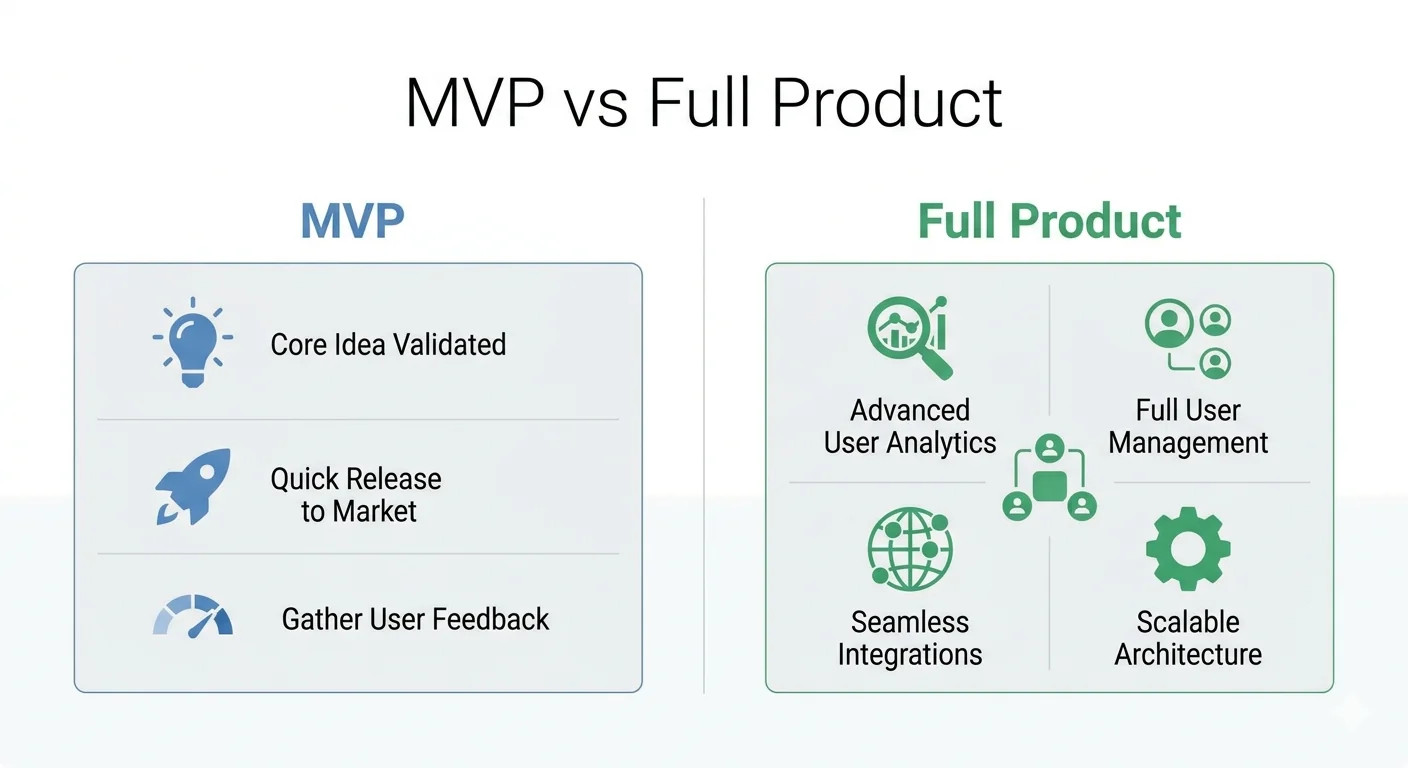
An MVP, or Minimum Viable Product, is the simplest version of your product that solves a core problem for users. It includes only the essential features needed to test your idea.
Instead of building everything at once, you start small and improve based on feedback.
Benefits of Building an MVP Early
- Saves time and development cost
- Helps validate your idea quickly
- Reduces risk of failure
- Gives real user feedback
- Helps you attract early users or investors
Real Example
Imagine you want to build a food delivery app. Instead of creating a full app with tracking, payments, and multiple features, your MVP could be a simple WhatsApp group where you take orders manually.
This approach helps you test demand before building a complex system.
👉 Join our Founder Partnership Program
If you are part of the Founder Partnership Program, you will get guidance to start with an MVP instead of building a full product.
Step 1: Identify the Problem You Want to Solve
Before building anything, you must clearly understand the problem.
Understanding User Pain Points
Ask yourself:
- What problem am I solving?
- Who is facing this problem?
- How are they solving it today?
The stronger the problem, the better your chances of success in product development and creating an MVP.
Market Research Basics
You do not need heavy research. Start simple:
- Talk to potential users
- Read online reviews
- Check competitors
- Look for gaps in the market
Common Mistakes Founders Make
- Building based on assumptions
- Ignoring real user feedback
- Solving a problem that is not urgent
A good MVP always starts with identifying a real problem, not just an idea.
Step 2: Define Your Target Audience
You cannot build a product for everyone.
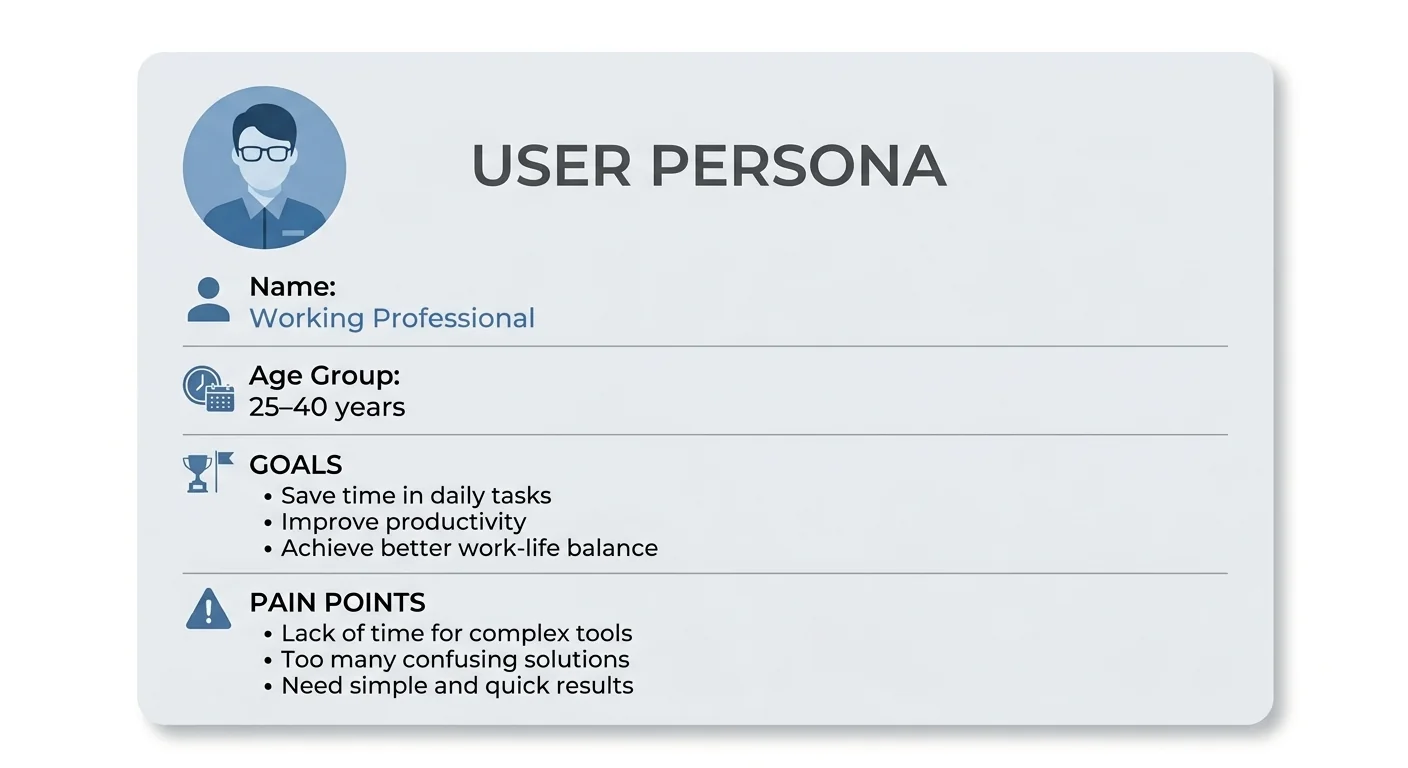
Creating User Personas
Define:
- Age group
- Profession
- Needs
- Challenges
For example:
"Busy working professionals who want quick meal options."
Narrowing Your Focus
Start small. Focus on one specific group instead of a broad market to achieve successful MVP results.
This helps you:
- Build better features
- Market effectively
- Get clearer feedback
Why "Everyone" Is Not Your Audience
If you target everyone, your product becomes unclear. A focused audience helps you build a stronger MVP.
👉 Join our Founder Partnership Program
Many founders refine their audience before building their MVP, and the Founder Partnership Program helps bring that clarity earlier in the process.
Step 3: Define Core Features Only
This is where most founders go wrong.
What to Include vs Exclude
Include only features that:
- Solve the main problem
- Are necessary for user experience
Exclude:
- Extra features
- Advanced design
- Nice-to-have options
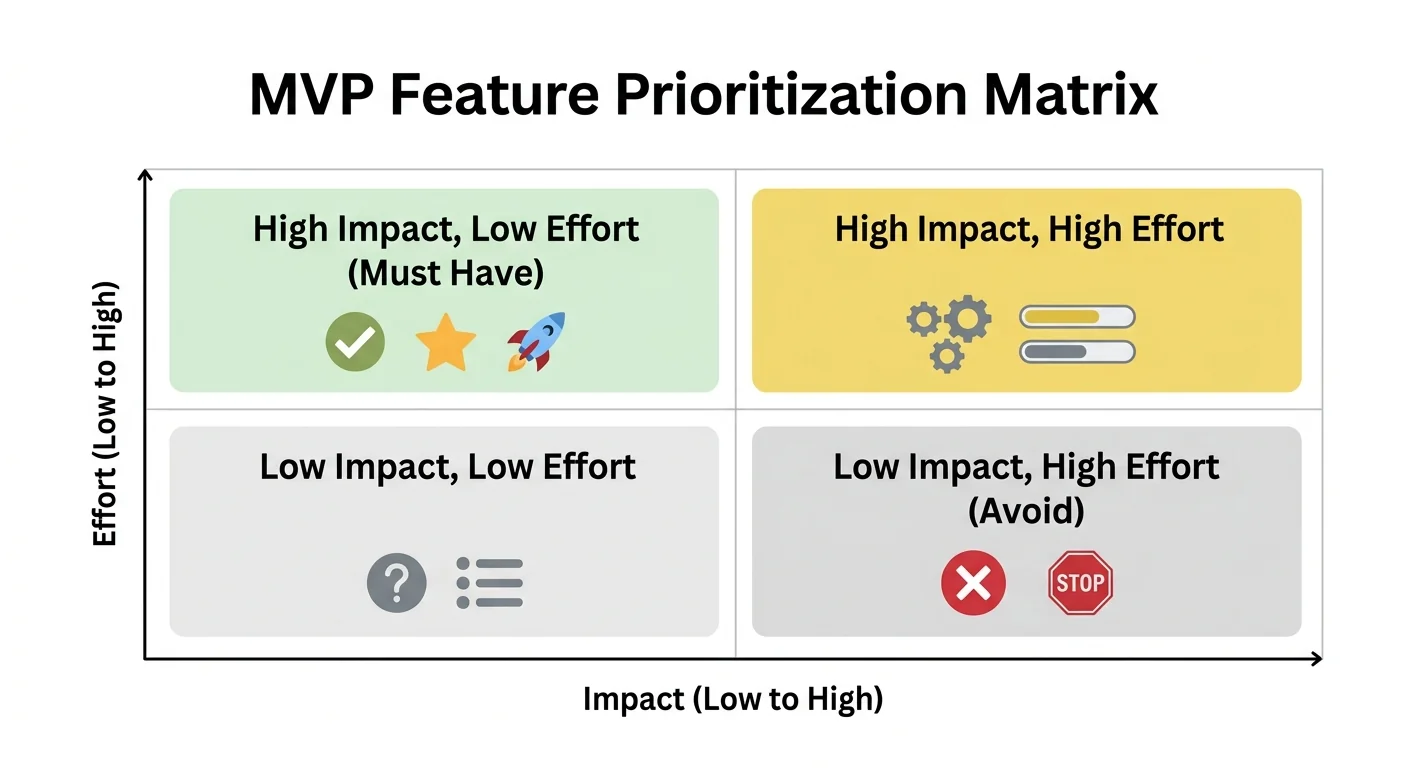
Feature Prioritization Method
Use this simple method:
- Must-have
- Good-to-have
- Not needed now
Focus only on must-have features for your MVP.
Avoiding Feature Overload
Adding too many features:
- Increases cost
- Delays the launch of the first MVP
- Confuses users
Your goal is not perfection, it is validation.
Step 4: Choose the Right MVP Type
Not all MVPs are the same.
Types of MVP
- Landing page MVP
- No-code MVP
- Prototype
- Concierge MVP (manual service)
When to Use Each
- Low budget → Landing page
- Quick testing → No-code tools
- Complex idea → Prototype
Budget vs Speed Decision
If you want faster validation, choose simple solutions like no-code tools or landing pages.
👉 Join our Founder Partnership Program
The Founder Partnership Program can help you choose the right MVP type based on your business model and growth goals.
Step 5: Build a Simple MVP Prototype
Now it is time to create something users can see and use.
Tools You Can Use
- Figma (for design)
- Canva (basic layouts)
- No-code tools like Webflow and Bubble
Wireframes vs Prototypes
- Wireframe = basic layout
- Prototype = clickable version of your product
Start with wireframes, then move to prototypes in your product development process.
Keep It Simple
Your MVP should:
- Be easy to use
- Solve one problem effectively
- Be quick to build
Avoid spending too much time on design. Focus on function.
Step 6: Test Your MVP with Real Users
Once your MVP is ready, the next step is testing it with real users.
Start with a Small Group
You do not need thousands of users. Start with:
- 10–20 target users
- Early adopters
- People who face the problem you are solving
Observe User Behavior
Instead of just asking questions, observe:
- How users interact with your product
- Where they get confused
- What they ignore
This gives you real insights that surveys often miss, which are crucial for your product launch.
Ask the Right Questions
Ask users questions like:
- What problem did this solve for you?
- What did you like the most?
- What was confusing or missing?
- Would you use this again?
Focus on learning, not proving your idea right.
👉 Join our Founder Partnership Program
Testing and refining with the right support can help founders move faster with more confidence.
Step 7: Collect Feedback and Improve
Testing alone is not enough. You need to act on feedback.
Types of Feedback to Focus On
- Feature requests
- Usability issues
- Performance problems
- User suggestions
Avoid This Common Mistake
Do not try to implement all feedback.
Instead:
- Look for patterns
- Identify common issues
- Prioritize based on impact to identify the features your product needs
Improve Step by Step
Make small improvements:
- Fix major issues first
- Improve user experience
- Add only important features
Your MVP should evolve based on real user needs.
Step 8: Launch Your MVP Publicly
After testing and improvements, it is time to launch.
Keep Your Launch Simple
You do not need a big launch. Start with:
- Social media posts
- Online communities
- Personal network
Focus on Early Traction
Your goal is to:
- Get users
- Collect feedback
- Build trust
Measure Basic Metrics
Track:
- Number of users
- Engagement
- Feedback
- Retention
These metrics help you decide your next steps.
Step 9: Iterate and Improve Your MVP Continuously
An MVP is not the final product. It is just the beginning.
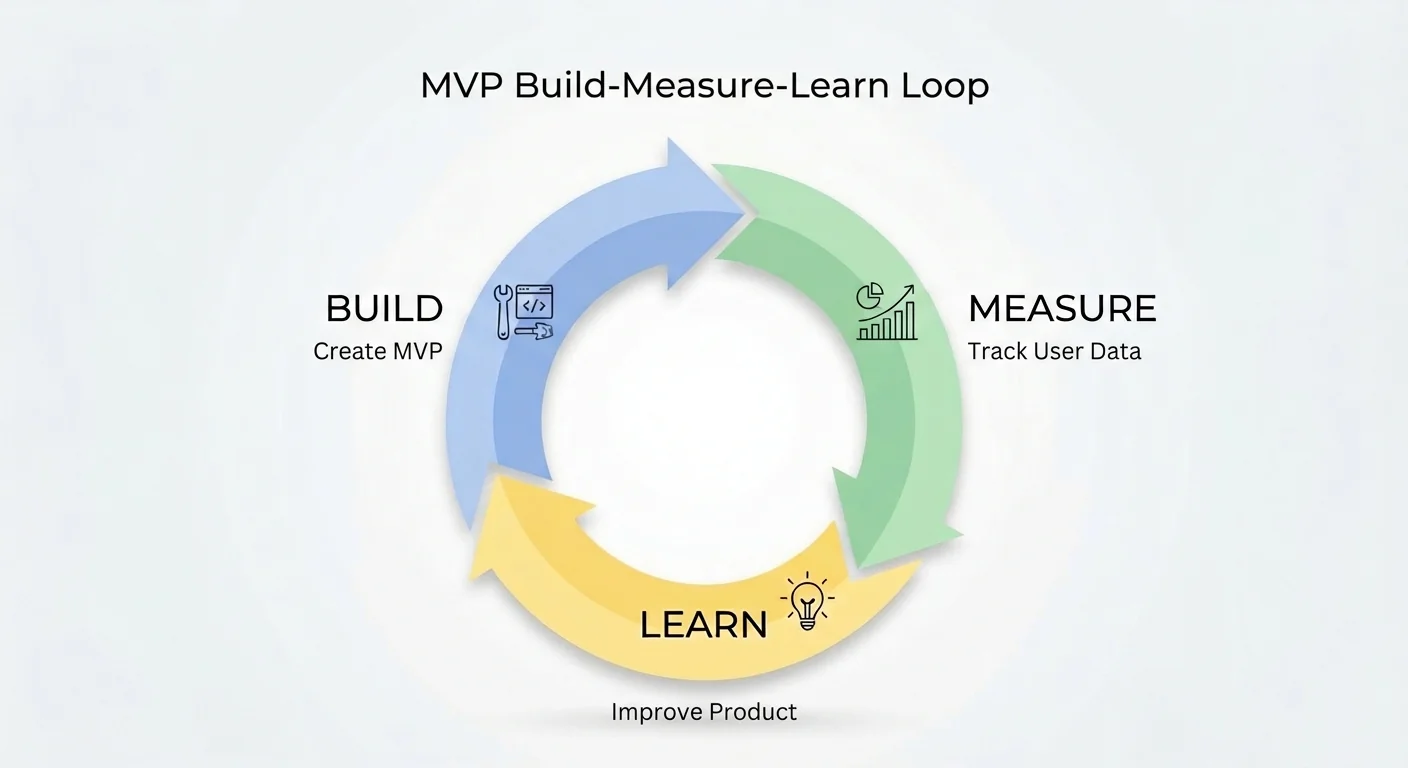
Build → Measure → Learn Cycle
Follow this cycle:
- Build small features
- Measure user response
- Learn and improve
- Repeat this process regularly
Focus on What Works
- Improve features users love
- Remove unused features
- Simplify the experience using lean startup methodology
Stay Close to Users
Always stay connected with your users:
- Talk to them regularly
- Ask for feedback to validate your product vision
- Understand their needs
This helps you build a better product over time.
Common Mistakes to Avoid While Building an MVP
Many startups fail because of avoidable mistakes.
1. Building Too Many Features
Trying to build everything at once:
- Increases cost
- Delays launch
- Confuses users
👉 Keep it simple.
2. Ignoring User Feedback
Some founders:
- Assume they know everything
- Ignore real user input
👉 Always listen to users.
3. Spending Too Much Time on Design
Design is important, but:
- Function matters more in MVP
- Users care about solving their problem
👉 Focus on usability first.
4. Not Defining a Clear Problem
If your problem is unclear:
- Your product will also be unclear
👉 Start with a strong problem statement.
5. Delaying Launch
Waiting for perfection can slow down the MVP journey.
- Slows down progress
- Increases risk
👉 Launch early and improve later.
Tools That Can Help You Build an MVP Faster
Here are some useful tools:
For Design
- Figma
- Canva
For No-Code Development
- Webflow
- Bubble
For Feedback Collection
- Google Forms
- Typeform
For Analytics
- Google Analytics
- Hotjar
These tools help you save time and build faster.
👉 Join our Founder Partnership Program
The right guidance can help you choose which tools actually matter for your stage, instead of wasting time on unnecessary setup.
How a Founder Partnership Program Can Help You Build an MVP
Building an MVP alone can be challenging, especially for software startups. Many founders make mistakes due to lack of guidance.
A Founder Partnership Program can help you:
- Validate your idea
- Define the right features
- Avoid common mistakes
- Get expert feedback
- Build faster and smarter
If you are serious about building your startup, joining the Founder Partnership Program can save you time and effort.
Advanced Insights, Example, and Practical MVP Planning
A Simple Example of How to Build an MVP
Sometimes the easiest way to understand how to build an MVP is through a simple example.
Let's say a founder wants to build a platform that helps students find internships more easily.
The full idea may include:
- Student profiles
- Employer dashboards
- AI matching
- Resume builder
- Chat system
- Application tracking
- Email alerts
- Interview scheduling
This sounds useful, but building all of this at once will take a lot of time and money.
So what should the MVP (Minimum Viable Product) be in terms of the job to be done?
The founder should first ask:
- What is the main problem?
- What is the fastest way to solve it?
- What is the minimum feature set required?
In this case, the main problem could be:
Students struggle to find relevant internship opportunities in one place.
So the MVP could simply be:
- A clean internship listing page
- A simple student application form
- Basic filtering by category or location
- Manual matching on the backend if needed
That is enough to start.
The founder does not need AI matching in the beginning. They do not need a complex dashboard. They do not need every feature they imagine for a successful business.
They only need a working solution that proves users want it.
This is the real purpose of an MVP: to test the core version of a new product.
A More Personal Example
For example, when building Internwise UK, the initial focus was not on creating a fully advanced platform with multiple features. Instead, the goal was to validate whether students and employers actually needed a simpler, more focused solution.
The early version focused on basic listings and a simple application process. This helped validate demand before investing in more advanced features.
This is exactly how an MVP should work: start simple, test real user behavior, and improve based on actual feedback.
How to Decide What Stays in the MVP and What Waits
Founders often struggle with feature decisions because every feature feels important for the future product.
A simple way to decide is to ask:
- Does this feature directly help solve the main problem?
- Can users still get value without this feature?
- Is this feature required for testing demand?
If the answer is no, remove it for now.
You can use this simple filter:
Keep in MVP
- Core user action
- Main problem solution
- Basic functionality needed to test the idea
Keep for Later
- Advanced customization
- Automation
- Premium design elements
- Extra dashboards
- Secondary tools
This approach helps you avoid overbuilding.
A Simple MVP Planning Table You Can Follow
Before starting development, founders should create a simple planning structure like this for building a minimum viable product:
1. Problem
What exact problem are you solving with your first product?
Example: Small business owners struggle to track customer orders in one place.
2. Target User
Who is facing this problem most often in the context of MVP creation?
Example: Small local businesses with manual order systems.
3. Core Outcome
What should the MVP help users do in terms of usability and new features?
Example: Track and update customer orders easily.
4. Core Features
What minimum features are needed?
Example:
- Order entry
- Order status update
- Customer name and contact field
- Basic dashboard
5. Success Metric
How will you know the MVP is working?
Example:
- 20 businesses sign up
- 10 use it weekly
- Positive feedback from first users
This planning method keeps your startup focused from day one.
How Founders Usually Waste Time While Building an MVP
Many founders do not fail because the idea is bad. They fail because they waste too much time on the wrong things.
Here are common time-wasting areas:
1. Too Much Time on Branding
A logo, color palette, and perfect website are not the first priority when defining your product vision. Your first priority is proving the product idea works.
2. Too Much Time on Design
A beautiful product that nobody needs will still fail.
3. Too Much Time on Features
Every extra feature increases confusion, cost, and launch delay.
4. Too Much Time Without User Contact
Some founders build in isolation. They do not talk to users until very late. This creates major risk.
5. Waiting for Perfect Readiness
You do not need perfect readiness. You need useful feedback.
The faster you test your idea, the stronger your learning becomes.
👉 Join our Founder Partnership Program
A strong support system can help reduce these mistakes by giving early direction and feedback.
What Founders Should Do Before Writing the First Line of Code
Before development starts, spend time on clarity.
Ask these questions:
- What problem is urgent enough for users to care about?
- Why would someone use this instead of their current method?
- What is the one thing this MVP should do well?
- What result should the first user get?
This step sounds simple, but it is very important.
If the founder is not clear, the product will not be clear either.
A good MVP is not just about building fast. It is about building the right first version.
Low-Cost Ways to Build an MVP
Many people think startup building requires a large budget. That is not always true.
You can build and test an MVP with limited money if your approach is smart.
Affordable MVP Options
1. Landing Page MVP
Create a single page explaining the product and let users sign up for interest.
Best for:
- Idea validation
- Early demand testing
- Lead collection
2. No-Code MVP
Use no-code tools to create basic product functionality and build your MVP.
Best for:
- Fast launch
- Limited budget
- Non-technical founders
3. Manual Service MVP
Do the work manually behind the scenes while users experience a simple process, ensuring market validation.
Best for:
- Service marketplaces
- Matching platforms
- Early validation
4. Clickable Prototype
Create a clickable design without full backend development.
Best for:
- Investor presentation
- Early user testing
- Product flow validation
This shows that founders do not always need a big team in the early stage.
👉 Join our Founder Partnership Program
A structured Founder Partnership Program can help founders choose a practical MVP path based on time, skill, and budget.
How to Know If Your MVP Is Actually Working
After launch, many founders ask an important question:
How do I know if the MVP is successful?
The answer is not only based on traffic or downloads. You should look deeper.
Signs Your MVP Is Working
- Users understand the product quickly
- Users return after the first visit
- Users complete the main action
- Users give positive feedback
- Users ask for more
- Users are willing to pay or join a waiting list
Warning Signs Your MVP Needs Improvement
- Users feel confused
- Users do not return
- Users do not see enough value
- Users drop off too early
- Nobody recommends it
These signs help you decide whether to improve, change direction, or simplify further in your product roadmap.
When to Improve the MVP and When to Pivot
Not every product idea should continue in the same direction.
Sometimes you should improve the MVP. Other times you should pivot.
Improve the MVP When:
- Users like the idea but face usability problems
- The core problem is valid
- Feedback shows clear demand
- Small changes can improve results
Pivot When:
- Users do not care about the problem
- Nobody sees value in the solution
- The target audience is wrong
- A different use case gets stronger interest
A pivot does not mean failure. It means you learned something important early.
That is one of the biggest benefits of MVP development.
A Practical Weekly MVP Execution Plan
Here is a simple plan founders can follow:
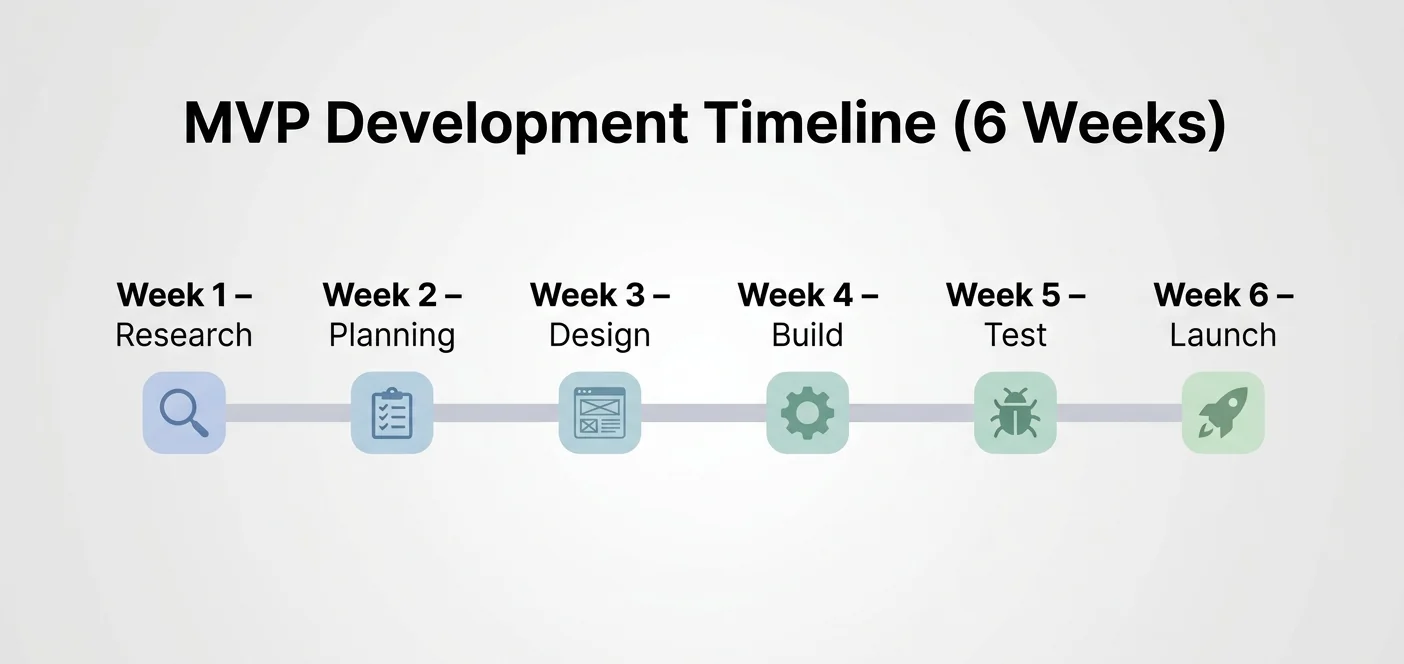
Week 1: Problem and Audience Research
- Talk to target users
- Validate the problem
- Study current solutions
- Write down pain points
Week 2: Feature Selection and MVP Scope
- Define the core problem
- Select minimum features
- Remove unnecessary ideas
- Finalize user journey
Week 3: Design or Prototype
- Create wireframes
- Build simple prototype
- Review user flow to ensure it aligns with your product vision
- Prepare testing version
Week 4: Build Basic MVP
- Use no-code or simple development
- Keep it functional
- Avoid extra features
- Focus on core experience
Week 5: User Testing
- Share with early users
- Observe real usage
- Collect feedback
- Track common problems
Week 6: Improve and Launch
- Fix major issues
- Improve the important parts of your product
- Launch publicly in a simple way
- Continue learning
This kind of plan makes MVP development more manageable.
How Mentorship Can Improve MVP Success
Building an MVP without guidance can lead to repeated mistakes.
A founder may:
- Build too much
- Target the wrong audience
- Launch too late
- Miss user signals
- Waste budget on unnecessary work
This is why mentorship matters.
A good Founder Partnership Program can help founders:
- Clarify the startup idea
- Focus on real user needs
- Plan better MVP scope
- Avoid expensive mistakes
- Build with more confidence
For many early-stage founders, the right support can save months of trial and error in developing product features.
Final Takeaway for Founders
If you want to know how to build an MVP, remember this: a scalable product management approach is important.
You do not need to launch a perfect product. You need to launch a useful first version.
Start with:
- One clear problem
- One clear audience
- One clear value
- Only the features that matter most
Then test, learn, improve, and grow.
That is how smart startups build products.
That is how founders reduce risk.
That is how better businesses begin.
Conclusion
Building an MVP is one of the most important steps in your startup journey to create a product that meets user needs.
Instead of spending months building a full product, you can start small, test your idea, and improve based on real feedback.
Let's quickly recap:
- Start with a clear problem
- Define your target audience
- Focus on core features only
- Build a simple version
- Test with real users
- Improve based on feedback
- Launch and iterate
If you follow this process, you will reduce risk and increase your chances of success.
Remember, your goal is not to build a perfect product. Your goal is to build a solution that works and improves over time, aligning with the principles of lean startup methodology.
If you are still wondering how to build an MVP, start simple, test fast, and improve based on real user feedback.
Ready to build your MVP the right way?
Join our Founder Partnership Program and get step-by-step guidance to validate, build, and launch your startup faster.
Stop guessing. Start building with clarity.
Related articles




Nuno Dhiren
Founder, Internwise
You've learned how to validate your startup idea. Now it's time to build it the right way. Our Founder Partnership Program gives you structured guidance, expert mentorship, and a clear roadmap to turn your validated idea into a real, profitable business.
Join other ambitious founders who are building sustainable startups from day one.