Customer Validation for Startups: How to Confirm Market Demand

What Is Customer Validation in a Startup?
Customer validation in a startup is the process of confirming whether real customers actually need and will use your product. It is not about what people say they might do. It is about observing real behaviour and decisions. In simple terms, validation means proving demand through actions such as sign-ups, pre-orders, or active interest.
The validation process helps founders move beyond assumptions and opinions. Many startups rely on feedback like "this sounds great", but that does not equal market validation. What truly matters is whether customers are willing to invest their time, attention, or money.
Market validation focuses on understanding if a real problem exists and whether your solution fits that need. It involves talking to potential customers, testing ideas in small ways, and learning from their responses.
For any startup, the goal is clear. Validate early, learn quickly, and build something that customers genuinely want rather than something that only looks good on paper.
Why Customer Validation Matters More Than Your Startup Idea
Many startups fail not because the founders lack passion or skills, but because there is no real demand in the market. It is easy to get attached to an idea and assume it will work, but without proper validation, this can quickly lead to wasted time and resources.
Ideas do not fail. Lack of demand does.
Skipping customer validation increases the risk of building something that no one actually needs. Founders may invest months developing a product, only to realise later that customers are not interested or willing to pay. This is where market demand plays a critical role. Validation helps you understand whether your idea solves a real problem and whether people value the solution enough to take action.
It also directly impacts your business model. Without validation, pricing, positioning, and growth strategies are based on guesswork. With validation, you build with clarity, confidence, and a much higher chance of success.
How to Validate the Problem Before the Solution
Most founders rush to build a solution before they fully understand the problem. This is where things start going wrong. The first step is to validate the problem, not the product. If the problem is not strong enough, even the best solution will struggle.
Start by clearly defining your problem statement. What exactly is the issue your target customer is facing? Is it frequent, frustrating, and important enough to fix? A problem that is worth solving usually shows up repeatedly in real conversations and behaviour.
To validate the problem, talk directly to potential customers. Ask about their current challenges, how they are solving them today, and what frustrates them the most. Pay close attention to patterns. If multiple people describe the same pain point in similar ways, that is a strong signal.
Avoid leading questions or pitching your idea too early. Focus on understanding the problem deeply. When you validate the problem first, you build a strong foundation. This ensures that when you move to the solution stage, you are solving something that truly matters.
Understanding Your Target Customers and Market
Before you validate your idea, you need clarity on who you are building for. Many founders confuse target customers with the broader target market. Your target market is the larger group that might benefit from your solution, while your target customers are the specific people most likely to use and pay for it.
For example, in a B2B startup, your market could be small and medium businesses, but your target customers might be founders or operations managers within those companies. This level of clarity helps you ask the right questions and gather more meaningful insights.
Market research plays a key role here. It helps you understand customer behaviour, needs, and expectations. At the same time, analysing your competitor gives you a clearer picture of what already exists and where gaps may lie.
By combining customer insights, market research, and competitor analysis, you can refine your positioning. This ensures you are not trying to serve everyone but focusing on the right customers who are most likely to validate your idea.
A Practical Customer Validation Framework for Startups
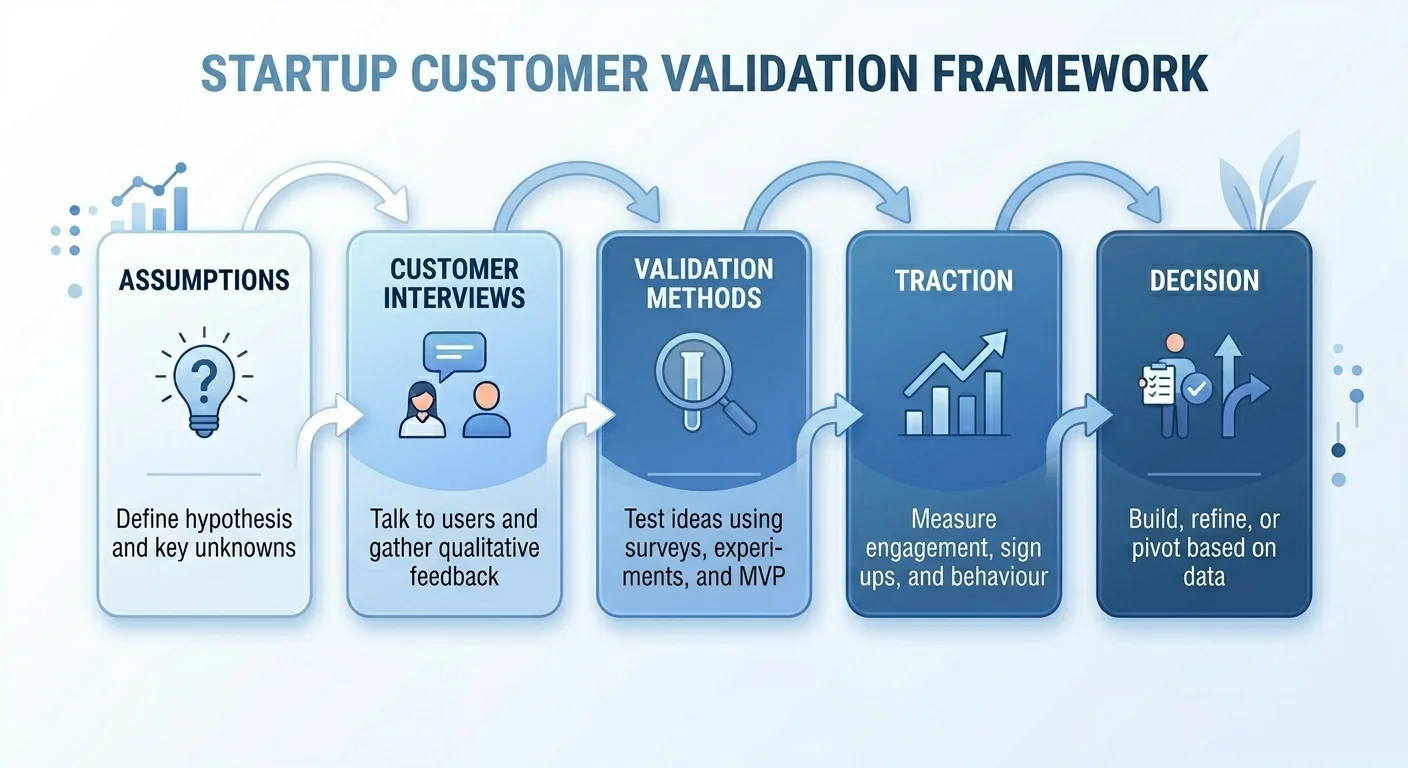
Customer validation for startups works best when you follow a simple and structured process. Instead of guessing, you move step by step and learn from real feedback and behaviour.
Step 1: Define assumptions and hypotheses
Start by identifying your key assumptions. What problem are you solving, and who is facing it? Write this as a clear hypothesis. For example, you might believe that small business owners struggle with tracking expenses and would prefer a simple digital tool. This gives you a starting point to test.
Step 2: Talk to real customers
Reach out to people who fit your target profile. Have honest conversations about their challenges, current solutions, and priorities. Avoid pitching your idea. Focus on listening and understanding their real experiences.
Step 3: Test interest with a landing page or waitlist
Create a simple landing page that explains your idea and the value it offers. Add a clear call to action such as joining a waitlist or signing up for early access. This helps you measure genuine interest beyond just conversations.
Step 4: Measure behaviour and traction
Look at how people actually respond. Are they signing up, clicking, or sharing? This early traction is a strong signal of demand. Behaviour matters more than opinions, so focus on actions that show intent.
Step 5: Decide to build, refine, or pivot
Based on what you learn, make a clear decision. If you see strong interest, move forward and build. If the response is mixed, refine your idea and test again. If there is little to no traction, it may be time to pivot and explore a different direction.
This framework keeps your validation process practical, focused, and grounded in real market signals.
Top Customer Validation Methods Every Founder Should Use
There is no single way to validate a startup idea. The best approach is to use a mix of methods that help you understand both what customers say and what they actually do.
Customer interviews are one of the most effective methods. Speaking directly with potential users helps you uncover real problems, motivations, and behaviours. Focus on open conversations rather than selling your idea.
A survey can help you gather broader insights from a larger group. It is useful for spotting patterns, but it should support, not replace, direct conversations. Keep questions simple and avoid leading responses.
Creating a landing page is a practical way to test interest. Clearly explain your value proposition and track how many people sign up or join a waitlist. This gives you a measurable signal of demand.
Building a simple MVP or minimum viable product allows you to test how users interact with your solution. It does not need to be perfect. The goal is to learn quickly with minimal effort.
Finally, explore communities where your target audience is active. Online forums, social platforms, and niche groups can provide honest feedback and early validation signals.
Using these methods together helps you validate smarter and reduce the risk of building something no one wants.
How to Confirm Market Demand Without Building a Product
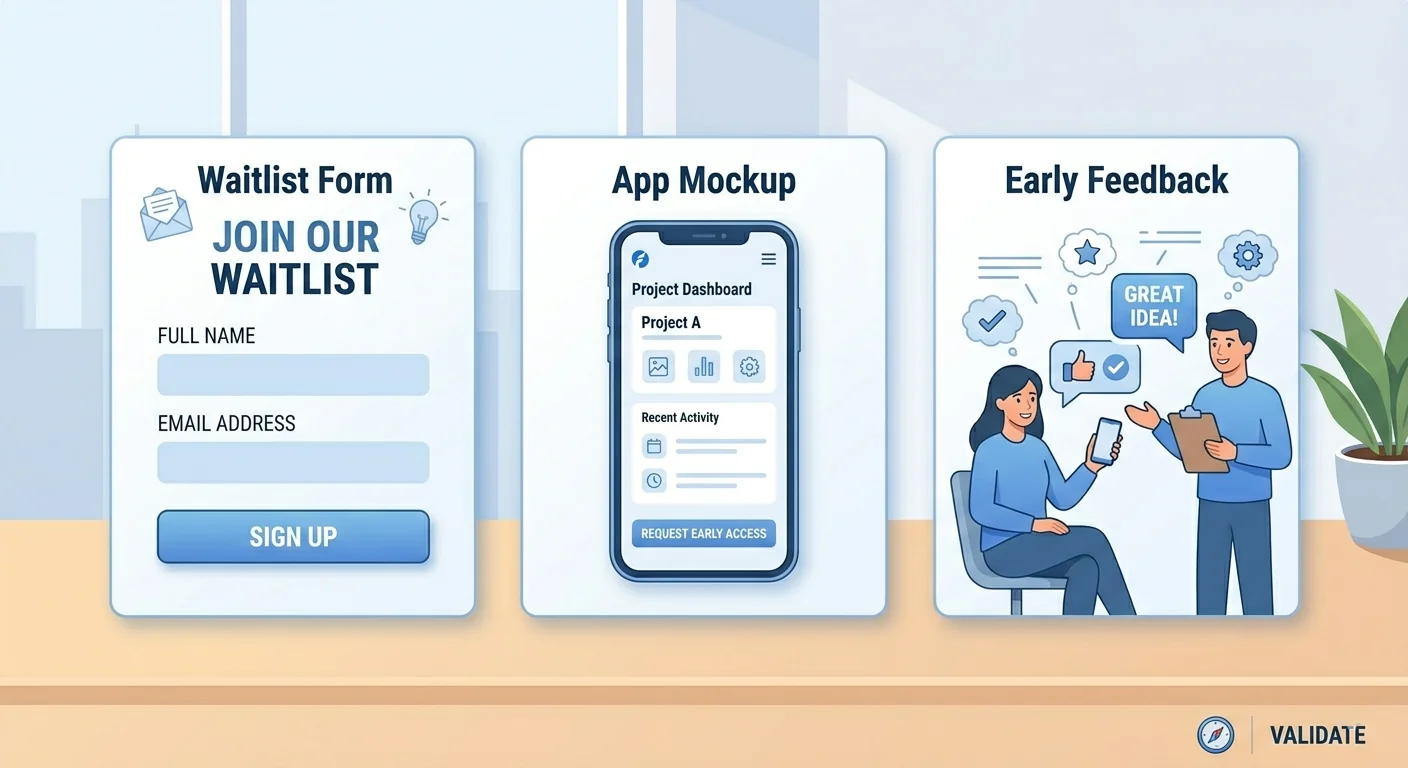
You do not need to build a full product to validate demand. In fact, early validation should focus on simple tests that reveal real interest and willingness to pay.
A waitlist is one of the easiest ways to start. Create a basic page that explains your idea and invite users to sign up for early access. If people are joining without much effort, it is a strong signal that the problem matters.
A fake door test goes one step further. You present a feature or product as if it already exists and track how many users click or try to access it. This helps you validate demand based on behaviour rather than assumptions.
Early landing pages can also be used to test different messages, pricing, and value propositions. You can even ask users if they are willing to pay or collect pre-orders.
The key is simple. Focus on actions that show intent. When users are willing to pay or show strong interest, you have clear proof to validate demand before building anything.
Using AI Tools for Faster Customer Validation
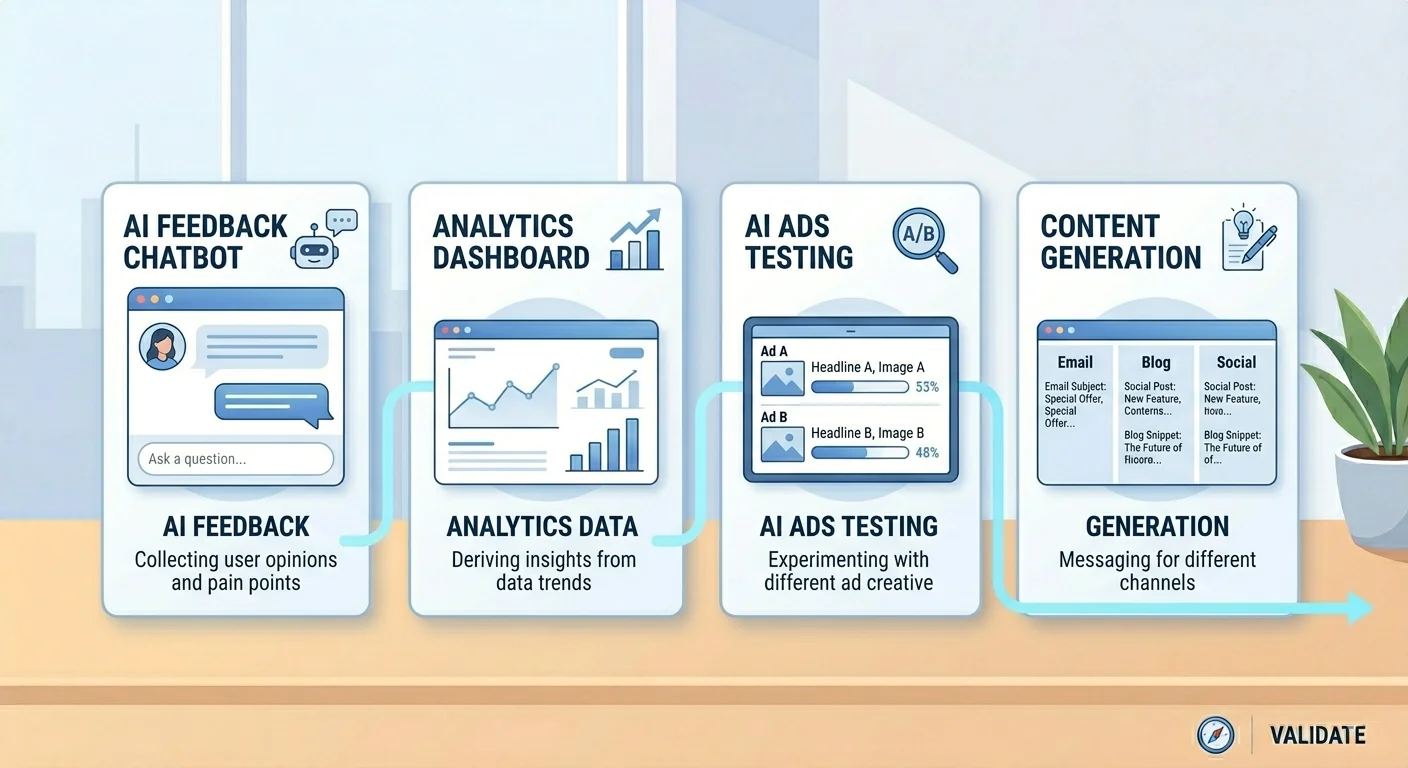
Customer validation can take time, but tools like AI can significantly speed up the process. Instead of manually analysing every conversation or response, you can use AI tools for insights that highlight patterns, common pain points, and customer behaviour more efficiently.
AI also helps with faster testing. You can quickly create landing pages, generate different messaging variations, and analyse which version performs better. This allows you to test multiple ideas in less time and make informed decisions based on real data.
When it comes to data analysis, AI tools can organise feedback from interviews, surveys, and user interactions. This makes it easier to identify trends and understand what your target customers actually care about.
However, tools should support your thinking, not replace it. Real conversations and human judgement still matter.
👉 Join our Founder Partnership Program
If you have already validated your idea and seen real signals from the market, the next step is turning that validation into a product that works in the real world. This is where many founders struggle, not with ideas, but with execution.
Common Mistakes Founders Make in Customer Validation
Many founders go through the validation process but still end up with misleading results because of avoidable mistakes. One of the most common issues is speaking to the wrong audience. If the people you are talking to are not your real target customers, their feedback will not reflect actual demand.
Another mistake is asking leading questions. When founders try to guide the conversation towards a positive response, they end up hearing what they want to hear rather than the truth. Asking the right questions is essential if you want honest and useful insights.
Ignoring negative customer feedback is also risky. It is easy to focus only on positive responses, but critical feedback often reveals the biggest gaps in your idea. These insights can help you improve or rethink your approach before investing further.
Effective validation is not about collecting praise. It is about understanding reality. By focusing on the right audience, asking the right questions, and taking customer feedback seriously, you can make better decisions and reduce the chances of failure.
When to Move Forward, Refine, or Pivot Your Startup Idea
After completing your validation process, the next step is deciding what to do with the insights you have gathered. The decision should be based on clear signals from the market, not assumptions.
If you are seeing strong signs such as consistent interest, engagement, and especially paying customers, it is a good indication that your idea is viable. These signals show that the problem is real and your solution is valuable enough for people to act on it.
If the response is mixed, it may be time to refine your approach. This could mean adjusting your value proposition, targeting a different customer segment, or improving how you present your solution.
On the other hand, weak signals such as low engagement, no willingness to pay, or unclear feedback suggest a deeper issue. In such cases, it is better to pivot rather than continue in the same direction.
Always consider market dynamics as well. Customer needs, competition, and timing can influence results. Making the right decision at this stage can save time and increase your chances of long-term success.
FAQ: Customer Validation for Startups
What is customer validation for startups?
Customer validation for startups is the process of confirming that real customers need your product and are willing to use or pay for it. It focuses on behaviour rather than opinions.
How do I validate demand quickly?
You can validate demand quickly by speaking to target customers, creating a simple landing page, and testing interest through a waitlist or early sign ups. Focus on real actions instead of just feedback.
Do I need an MVP?
No, you do not always need a minimum viable product at the start. You can validate demand using interviews, landing pages, and simple tests before building anything.
How to know if an idea is viable?
An idea is viable when you see strong signals such as consistent interest, engagement, and paying customers. Willingness to act is the clearest sign of real demand.
Key Takeaways
- Focus on validating customers, not just your idea
- Prioritise real behaviour over opinions or compliments
- Start small and test before investing time and money
- Look for clear signals such as interest, engagement, and willingness to pay
- Avoid building too early without proper validation
- Use multiple methods to confirm demand and reduce risk
Customer validation helps you make smarter decisions and build with confidence rather than guesswork.
Ready to Move from Validation to Building?
Once you have validated your idea and confirmed real demand, the next step is turning those insights into a product that delivers value. This stage is where many founders feel uncertain, especially around execution, prioritisation, and scaling the right way.
👉 Join our Founder Partnership Program
The Founder Partnership Program is designed for founders who have already validated their idea and are ready to move forward. It helps you focus on building, refining, and launching with clarity, based on practical startup experience.
Instead of figuring everything out on your own, you can move ahead with a structured approach and a stronger foundation.
Related articles




Nuno Dhiren
Founder, Internwise
You've learned how to validate your startup idea. Now it's time to build it the right way. Our Founder Partnership Program gives you structured guidance, expert mentorship, and a clear roadmap to turn your validated idea into a real, profitable business.
Join other ambitious founders who are building sustainable startups from day one.